
Bengal
Also called Bengal cat
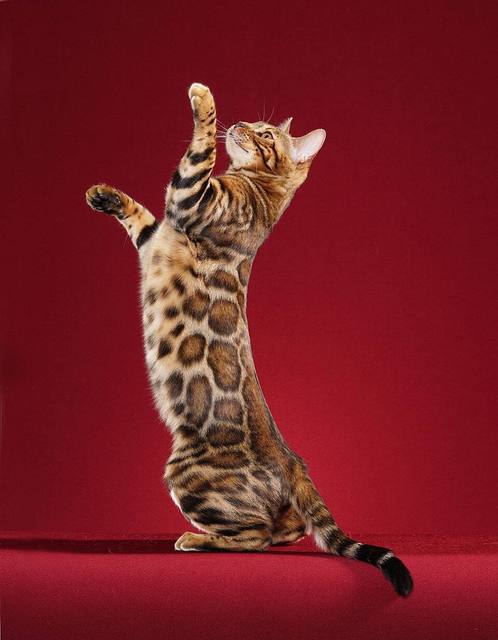
The Bengal is a medium cat from the United States, usually 3.5–7 kg, with a short coat, that needs about an hour of play a day. It is known for being Energetic, Clever, Curious, Playful and Confident.
Is your cat a Bengal? Scan a photo to see which breeds it looks most like.
Scan a photo of your catRestricted by law in some countries
- Australia: Import ban. Bengal cats may no longer be imported into Australia: the exemption for cats five generations from the Asian leopard cat has ended. This is a federal import rule; it says nothing about Bengals already in Australia. The rule Another source Another source Another source
- Belgium: Restricted. In the Brussels region a hybrid cat such as the Savannah or Chausie needs an official approval (agrement) to be kept, while a Bengal needs no approval only from the fifth generation. The rule Another source Another source
- Singapore: Restricted. First to fourth generation Bengal and Savannah crosses are on the list of cats not allowed into Singapore; a Bengal or Savannah cross at least five generations from the wild ancestor (Prionailurus bengalensis, Leptailurus serval) can be imported with documentary proof of its generation. The rule
- Switzerland: Restricted. The first two generations of crosses between a wild cat and a domestic cat (for example early Savannah, Bengal and Chausie) are treated as wild animals and a private keeper needs a permit, and they may not be used for breeding; later generations may be kept as ordinary cats, and deliberately mating a domestic cat with a wild cat is banned. The rule Another source
Check the rules where you live before you get one: a state, province, council or city can have rules of its own.
Interesting fact
Jean Mill, a Californian, made the earliest recorded planned mating between an Asian leopard cat and a house cat in 1963. The name is taken from the wild cat's scientific name, Prionailurus bengalensis.
Traits
Scores from 1 to 5 are tendencies, not a promise about one cat.
Living with one
A powerful, athletic cat that climbs, opens cupboards and wants a job to do. It is bold with visitors and bonds firmly with its household, but it is not a placid lap cat and gets destructive when bored. It can live indoors only with a lot of space, climbing and daily play, and is happier with a safe outdoor run.
Play
An hour or more of active play a day. Bengals fetch, learn tricks, walk on a harness and often enjoy running water, so give them tall trees, puzzle toys and a person who joins in.
Grooming
The short, plush coat sheds little and has a sheen that needs only a weekly stroke with a soft brush or a rubber mitt.
Health
- An inherited thickening of the heart muscle occurs in the breed.
- An inherited eye condition that leads to blindness occurs in some lines.
- Some lines carry a lack of an enzyme in red blood cells that causes anaemia.
General information, not veterinary advice. A vet, or the breeder or shelter, can tell you more about one particular cat.
Questions people ask about the Bengal
How big is the Bengal?
The Bengal is a medium cat, usually 3.5–7 kg.
What is the Bengal's coat like, and how much grooming does it need?
The Bengal has a short coat. It scores 1 out of 5 for grooming. The short, plush coat sheds little and has a sheen that needs only a weekly stroke with a soft brush or a rubber mitt.
Does the Bengal shed?
The Bengal sheds little, scoring 2 out of 5 for shedding. It has a low-shedding coat.
Does the Bengal suit indoor life?
The Bengal needs extra space and plenty to do to be happy indoors. It scores 2 out of 5 for indoor life.
Is the Bengal good with young children?
The Bengal is fine with calm, respectful children and an adult watching. It scores 3 out of 5 for young children. These are tendencies, not a promise about one cat.
How does the Bengal get on with other cats and with dogs?
The Bengal gets on with other cats after a slow introduction, and usually gets on well with a cat-friendly dog. It scores 3 out of 5 with other cats and 4 out of 5 with dogs. How a cat was handled as a kitten matters too.
How much play does the Bengal need?
It needs about an hour of play a day. Bengals fetch, learn tricks, walk on a harness and often enjoy running water, so give them tall trees, puzzle toys and a person who joins in.
How long can the Bengal be left alone?
The Bengal does not like being left for long and does best with company. It scores 2 out of 5 for time alone.
Updated 21 November 2026. Facts checked against the breed's Wikipedia article and breed standards on 20 November 2026.
Not sure your cat is a Bengal?
Identify a cat's breed from a photo See the Bengal in the appOn our lists
- Low-shedding cats number 9
- Playful cats number 3