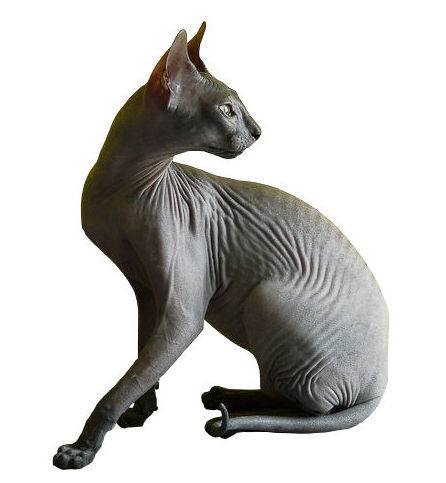

Donskoy
Also called Donskoy cat, Don Hairless, Don Sphynx, Russian Hairless
The Donskoy is a medium cat from Russia, usually 3–5 kg, with a hairless coat, that needs about 45 minutes of play a day. It is known for being Affectionate, Sociable, Curious and Clever.
Is your cat a Donskoy? Scan a photo to see which breeds it looks most like.
Scan a photo of your catRestricted by law in some countries
- Netherlands: Banned. Since 1 January 2026 it is against the law to keep a cat with folded ears or a hairless cat (no functional coat), and breeding with them was already banned; a cat that was kept and microchipped before 1 January 2026 may be kept for life and may be sold on, but may not take part in shows. The rule Another source Another source
Check the rules where you live before you get one: a state, province, council or city can have rules of its own.
Interesting fact
The breed traces to one kitten, Varvara, a rescued blue tortoiseshell found in 1987 in Rostov-on-Don, Russia, who began to lose her fur at about four months. It is not related to the Sphynx.
Traits
Scores from 1 to 5 are tendencies, not a promise about one cat.
Living with one
A wrinkled, sociable cat that wants to be near you and does not like long days alone. It is usually fine with children, other cats and a dog it has been introduced to carefully. It lives indoors, kept warm in winter and out of strong sun.
Play
About 45 minutes of play a day. It spends more time moving about than most cats, so toys, climbing places and a playmate help keep it busy.
Grooming
Bare skin gets oily, so it needs wiping or a bath every week or two, but too much washing makes it oilier. Clean the ears and keep the claws trimmed, as oil builds up on them.
Health
- Bare skin offers little protection from cold, and it can sunburn.
- The hairless gene can bring poor teeth and sweating problems when a cat inherits two copies.
- Breeding for hairlessness is banned in the Netherlands on welfare grounds.
General information, not veterinary advice. A vet, or the breeder or shelter, can tell you more about one particular cat.
Questions people ask about the Donskoy
How big is the Donskoy?
The Donskoy is a medium cat, usually 3–5 kg.
What is the Donskoy's coat like, and how much grooming does it need?
The Donskoy has a hairless coat. It scores 3 out of 5 for grooming. Bare skin gets oily, so it needs wiping or a bath every week or two, but too much washing makes it oilier.
Does the Donskoy shed?
The Donskoy sheds very little, scoring 1 out of 5 for shedding. It has a low-shedding coat.
Does the Donskoy suit indoor life?
The Donskoy suits indoor life well. It scores 4 out of 5 for indoor life.
Is the Donskoy good with young children?
The Donskoy is usually good with young children. It scores 4 out of 5 for young children. These are tendencies, not a promise about one cat.
How does the Donskoy get on with other cats and with dogs?
The Donskoy usually enjoys other cats, and can live with a calm dog after a careful introduction. It scores 4 out of 5 with other cats and 3 out of 5 with dogs. How a cat was handled as a kitten matters too.
How much play does the Donskoy need?
It needs about 45 minutes of play a day. It spends more time moving about than most cats, so toys, climbing places and a playmate help keep it busy.
How long can the Donskoy be left alone?
The Donskoy does not like being left for long and does best with company. It scores 2 out of 5 for time alone.
Updated 21 November 2026. Facts checked against the breed's Wikipedia article and breed standards on 20 November 2026.
Not sure your cat is a Donskoy?
Identify a cat's breed from a photo See the Donskoy in the appOn our lists
- Low-shedding cats number 4
- Lap cats number 8
- Playful cats number 14