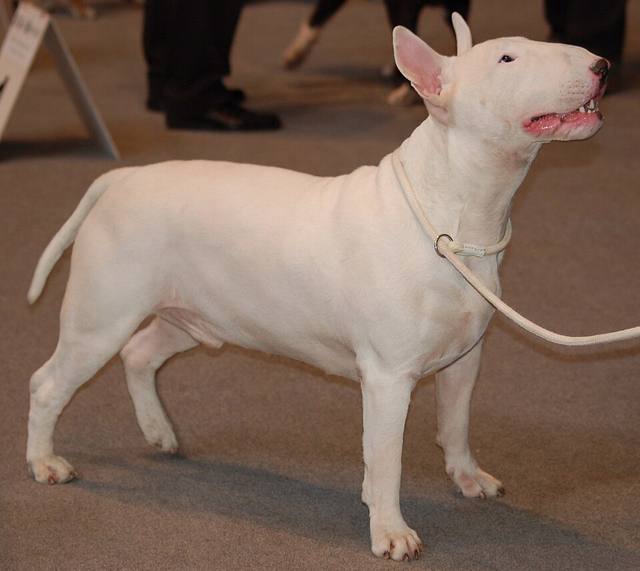

Bull Terrier
Also called English Bull Terrier, Hinks Bull Terrier
The Bull Terrier is a large dog from England, usually 20–30 kg and 45–56 cm at the shoulder, that needs about an hour of exercise a day. It is known for being Playful, Affectionate, Energetic and Independent.
Is your dog a Bull Terrier? Scan a photo to see which breeds it looks most like.
Scan a photo of your dogRestricted by law in some countries
- Germany: Import ban. The law calls it “Bull Terrier”. Dogs of these breeds, and their crosses with one another or with other dogs, may not be imported or brought into Germany, with exceptions such as a visit of no more than four weeks; a federal state can class further breeds as dangerous, and those may then not be brought in to be kept there. The rule
- Ireland: Restricted. The law calls it “English Bull Terrier”. Must be securely muzzled and led on a strong leash of at most two metres by someone over 16 who can control the dog whenever it is in a public place; the same applies to its strains and crosses (S.I. No. 442 of 1998, regulation 5). The rule Another source
Check the rules where you live before you get one: a state, province, council or city can have rules of its own.
Interesting fact
Known for its egg-shaped head. The breed was created in England in the mid-1800s by James Hinks, who crossed the old bull-and-terrier fighting dogs with the now-extinct English White Terrier.
Traits
Scores from 1 to 5 are tendencies of the breed, not a promise about one dog.
Living with one
A muscular clown with an egg-shaped head, full of energy and devoted to its people. Bull Terriers are strong, stubborn and rough in play, and many do not get on with other dogs or small pets, so they need firm, good-humoured training from the start. Some countries restrict the breed.
Exercise
About an hour a day of brisk walks and energetic play, with training games to occupy the mind. A bored Bull Terrier chews and digs.
Grooming
The short, flat coat needs only a weekly brush or wipe. White dogs can sunburn on the ears and nose.
Health
- Deafness is common in white Bull Terriers.
- Skin allergies are common in the breed.
- Kneecaps that slip out of place occur in the breed.
- Inherited kidney and heart conditions occur in the breed.
General information, not veterinary advice. A vet, or the breeder or shelter, can tell you more about one particular dog.
Lifespan: McMillan et al. 2024, an open UK study.
Questions people ask about the Bull Terrier
How big is the Bull Terrier?
The Bull Terrier is a large breed, usually 20–30 kg and 45–56 cm at the shoulder.
How much exercise does the Bull Terrier need?
It needs about an hour of exercise a day. A bored Bull Terrier chews and digs.
Is the Bull Terrier good with young children and other pets?
On a scale of 1 to 5, where 5 is easiest, the breed scores 3 for young children, 2 for other dogs, 2 for cats and small pets. These are tendencies of the breed, not a promise about one dog.
Does the Bull Terrier shed, and how much grooming does it need?
The Bull Terrier scores 3 out of 5 for shedding and 1 out of 5 for grooming. The short, flat coat needs only a weekly brush or wipe.
Updated 21 November 2026. Facts checked against the breed's Wikipedia article and breed standards on 20 November 2026.
Not sure your dog is a Bull Terrier?
Scan a photo in Kagn Dogs See the Bull Terrier in the app