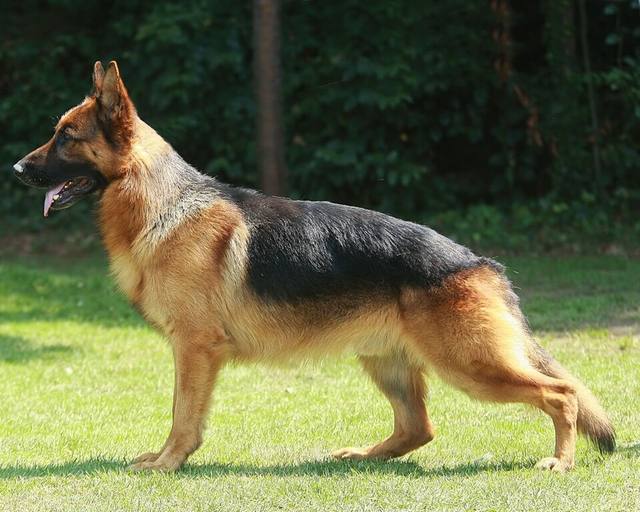

German Shepherd
Also called Alsatian, Alsatian dog, Alsatian wolf dog, Berger Allemand, Deutscher Schäferhund, German Shepherd Dog, GSD, Schäferhund
The German Shepherd is a large dog from Germany, usually 22–40 kg and 55–65 cm at the shoulder, that needs about two hours of exercise a day. It is known for being Loyal, Clever, Protective, Confident and Eager to please.
Is your dog a German Shepherd? Scan a photo to see which breeds it looks most like.
Scan a photo of your dogRestricted by law in some countries
- Ireland: Restricted. The law calls it “German Shepherd (Alsatian)”. Must be securely muzzled and led on a strong leash of at most two metres by someone over 16 who can control the dog whenever it is in a public place; the same applies to its strains and crosses (S.I. No. 442 of 1998, regulation 5). The rule Another source
Check the rules where you live before you get one: a state, province, council or city can have rules of its own.
Interesting fact
Developed in Germany from 1899 as a herding dog. When Germany began training guide dogs for blinded soldiers in 1916, German Shepherds were the breed it used.
Traits
Scores from 1 to 5 are tendencies of the breed, not a promise about one dog.
Living with one
A capable working dog that bonds closely with its family and watches over it. German Shepherds need a job, training and company; left bored or alone they can become noisy and hard to manage.
Exercise
About two hours a day, with something for the mind as well as the legs: training, scent games or a dog sport on top of walks.
Grooming
The thick double coat sheds a great deal, all year. Brush two or three times a week, and expect to vacuum often.
Health
- Hip and elbow problems are common in the breed.
- A spinal disease of older dogs occurs in the breed.
- A pancreas disease that affects digestion occurs in the breed.
- Bloat, a twisted stomach, occurs in deep-chested breeds.
General information, not veterinary advice. A vet, or the breeder or shelter, can tell you more about one particular dog.
Lifespan: McMillan et al. 2024, an open UK study.
Questions people ask about the German Shepherd
How big is the German Shepherd?
The German Shepherd is a large breed, usually 22–40 kg and 55–65 cm at the shoulder.
How much exercise does the German Shepherd need?
It needs about two hours of exercise a day.
Is the German Shepherd good with young children and other pets?
On a scale of 1 to 5, where 5 is easiest, the breed scores 4 for young children, 3 for other dogs, 3 for cats and small pets. These are tendencies of the breed, not a promise about one dog.
Does the German Shepherd shed, and how much grooming does it need?
The German Shepherd scores 5 out of 5 for shedding and 3 out of 5 for grooming. The thick double coat sheds a great deal, all year.
Updated 21 November 2026. Facts checked against the breed's Wikipedia article and breed standards on 20 November 2026.
Not sure your dog is a German Shepherd?
Scan a photo in Kagn Dogs See the German Shepherd in the appOn our lists
- Easy-to-train dogs number 12
- Guard dogs and watchdogs number 1