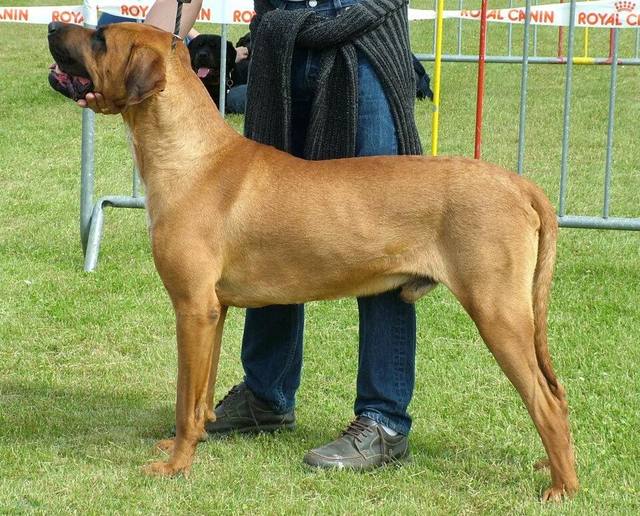

Tosa
Also called Japanese Fighting Dog, Japanese Mastiff, Japanese Tosa, Tosa Fighting Dog, Tosa Inu, Tosa Tōken
The Tosa is a large dog from Japan, usually 36–90 kg and 55–82 cm at the shoulder, that needs about an hour of exercise a day. It is known for being Calm, Loyal, Protective, Reserved with strangers and Confident.
Is your dog a Tosa? Scan a photo to see which breeds it looks most like.
Scan a photo of your dogRestricted by law in some countries
- Australia: Import ban. The law calls it “Japanese tosa”. These breeds may not be imported into Australia, under the Customs (Prohibited Imports) Regulations 1956. The rule
- Denmark: Banned. The law calls it “Tosa inu”. The Dog Act forbids owning and breeding these breeds and any cross with one of them in it, and nobody, tourists included, may bring one into Denmark except in transit; there are no exemptions. The rule
- France: Restricted. The law calls it “Tosa”. A Tosa with a pedigree is a category 2 'guard and defence dog': it may be kept with a permit from the mayor, on a lead and muzzled in public. A Tosa-like dog without a pedigree is category 1 and may not be bought, sold, given away or brought into France. The rule
- Ireland: Restricted. The law calls it “Japanese Tosa”. Must be securely muzzled and led on a strong leash of at most two metres by someone over 16 who can control the dog whenever it is in a public place; the same applies to its strains and crosses (S.I. No. 442 of 1998, regulation 5). The rule Another source
- New Zealand: Import ban. The law calls it “Japanese Tosa”. Dogs of these breeds and types may not be brought into New Zealand, unless the dog is already registered under the Dog Control Act 1996 or is a guide, hearing or companion dog. A dog that is wholly or mostly of one of these breeds and already lives in New Zealand is classed as menacing under that Act, whatever its behaviour, and must be muzzled in public. The rule Another source
- Norway: Banned. The law calls it “Tosa Inu (also called Tosa-Ken or Japanese Mastiff)”. It is against the law to own, breed or import these six breeds or any cross with one of them in it, in any proportion, or to import their semen or embryos. The rule
- Singapore: Banned. The law calls it “Tosa”. Singapore's Animal & Veterinary Service lists these breeds, and crosses of them, as dogs not allowed in Singapore; none may be brought in. The rule
- Spain: Restricted. The law calls it “Tosa Inu”. A dog of these breeds or their crosses, or one with the build the decree describes, is a 'potentially dangerous dog': its keeper needs a licence from the town hall (an adult with no record of certain offences, proof of physical and psychological fitness and third-party insurance), and in public it must wear a muzzle and be on a lead or chain shorter than two metres, one such dog per person (Royal Decree 287/2002). The regions add rules of their own. The rule
- United Kingdom: Banned. The law calls it “Japanese Tosa”. It is against the law to own a dog of these types, judged by what it looks like rather than its breed or name, or to sell, abandon, give away or breed from one; a dog with a Certificate of Exemption may be kept, neutered, microchipped, and on a lead and muzzled in public. The rule
Check the rules where you live before you get one: a state, province, council or city can have rules of its own.
Interesting fact
Bred from the 1870s in Tosa, on the Japanese island of Shikoku, by crossing the native Shikoku dog with bulldogs, mastiffs and other European breeds. In Japan the dogs are likened to sumo wrestlers.
Traits
Scores from 1 to 5 are tendencies of the breed, not a promise about one dog.
Living with one
A very large, quiet and composed mastiff, bred in Japan as a fighting dog and loyal to the family it knows. A Tosa is often aggressive towards other dogs and is too strong for most people to hold, so it is a dog for a very experienced owner only. Many countries ban or restrict the breed.
Exercise
About an hour a day of steady walking on the lead, away from other dogs. A large, securely fenced garden matters more than distance.
Grooming
The short, dense coat needs only an occasional brush and sheds little. Expect some drool.
Health
- Hip problems occur, as in other large breeds.
- Bloat, a twisted stomach, occurs in deep-chested breeds.
General information, not veterinary advice. A vet, or the breeder or shelter, can tell you more about one particular dog.
Questions people ask about the Tosa
How big is the Tosa?
The Tosa is a large breed, usually 36–90 kg and 55–82 cm at the shoulder.
How much exercise does the Tosa need?
It needs about an hour of exercise a day. A large, securely fenced garden matters more than distance.
Is the Tosa good with young children and other pets?
On a scale of 1 to 5, where 5 is easiest, the breed scores 2 for young children, 1 for other dogs, 2 for cats and small pets. These are tendencies of the breed, not a promise about one dog.
Does the Tosa shed, and how much grooming does it need?
The Tosa scores 2 out of 5 for shedding and 1 out of 5 for grooming. The short, dense coat needs only an occasional brush and sheds little.
Updated 21 November 2026. Facts checked against the breed's Wikipedia article and breed standards on 20 November 2026.
Not sure your dog is a Tosa?
Scan a photo in Kagn Dogs See the Tosa in the app