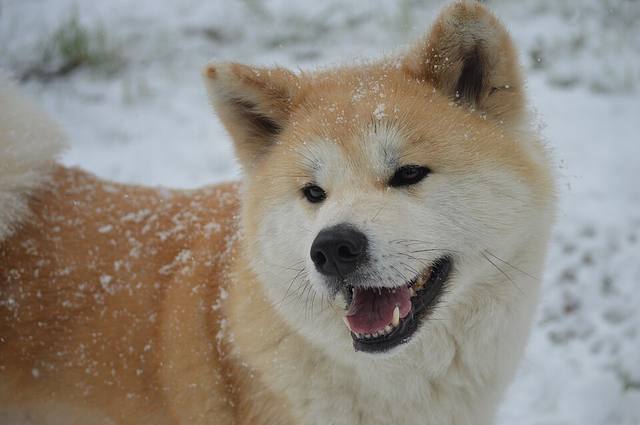

Akita
Also called Akita Inu, Japanese Akita, Japanese Akitainu
The Akita is a large dog from Japan and the United States, usually 25–55 kg and 58–71 cm at the shoulder, that needs about an hour and a half of exercise a day. It is known for being Loyal, Independent, Protective, Reserved with strangers and Confident.
Is your dog an Akita? Scan a photo to see which breeds it looks most like.
Scan a photo of your dogRestricted by law in some countries
- Ireland: Restricted. The law calls it “Japanese Akita”. Must be securely muzzled and led on a strong leash of at most two metres by someone over 16 who can control the dog whenever it is in a public place; the same applies to its strains and crosses (S.I. No. 442 of 1998, regulation 5). The rule Another source
- Singapore: Banned. The law calls it “Akita”. Singapore's Animal & Veterinary Service lists these breeds, and crosses of them, as dogs not allowed in Singapore; none may be brought in. The rule
- Spain: Restricted. The law calls it “Akita Inu”. A dog of these breeds or their crosses, or one with the build the decree describes, is a 'potentially dangerous dog': its keeper needs a licence from the town hall (an adult with no record of certain offences, proof of physical and psychological fitness and third-party insurance), and in public it must wear a muzzle and be on a lead or chain shorter than two metres, one such dog per person (Royal Decree 287/2002). The regions add rules of their own. The rule
Check the rules where you live before you get one: a state, province, council or city can have rules of its own.
Interesting fact
Hachikō, an Akita, waited at Tokyo's Shibuya station every day for nine years after his owner died in 1925. A bronze statue of him stands there, and Japan declared the breed a natural monument in 1931.
Traits
Scores from 1 to 5 are tendencies of the breed, not a promise about one dog.
Living with one
A dignified, powerful dog, deeply loyal to its own family and aloof with everyone else. Akitas are often intolerant of other dogs and too strong and proud for small children, so they need a calm, experienced owner and a secure fence. There are two types, the lighter Japanese Akita and the heavier American Akita.
Exercise
About an hour and a half a day of steady walking, on the lead wherever other dogs or small animals may appear. They enjoy cold weather and tire quickly in heat.
Grooming
The thick double coat needs brushing twice a week. Twice a year the undercoat comes out in handfuls for a few weeks, and daily brushing helps.
Health
- Immune-system conditions affecting the skin and eyes occur in the breed.
- Hip and elbow problems occur in the breed.
- Bloat, a twisted stomach, occurs in the breed.
- An underactive thyroid occurs in the breed.
General information, not veterinary advice. A vet, or the breeder or shelter, can tell you more about one particular dog.
Lifespan: McMillan et al. 2024, an open UK study.
Questions people ask about the Akita
How big is the Akita?
The Akita is a large breed, usually 25–55 kg and 58–71 cm at the shoulder.
How much exercise does the Akita need?
It needs about an hour and a half of exercise a day. They enjoy cold weather and tire quickly in heat.
Is the Akita good with young children and other pets?
On a scale of 1 to 5, where 5 is easiest, the breed scores 1 for young children, 1 for other dogs, 1 for cats and small pets. These are tendencies of the breed, not a promise about one dog.
Does the Akita shed, and how much grooming does it need?
The Akita scores 5 out of 5 for shedding and 3 out of 5 for grooming. The thick double coat needs brushing twice a week.
Updated 21 November 2026. Facts checked against the breed's Wikipedia article and breed standards on 20 November 2026.
Not sure your dog is an Akita?
Scan a photo in Kagn Dogs See the Akita in the appOn our lists
- Dogs that cope with time alone number 11
- Guard dogs and watchdogs number 12